

Cold Crimp vs Solder Terminals ——Which Is More Reliable?
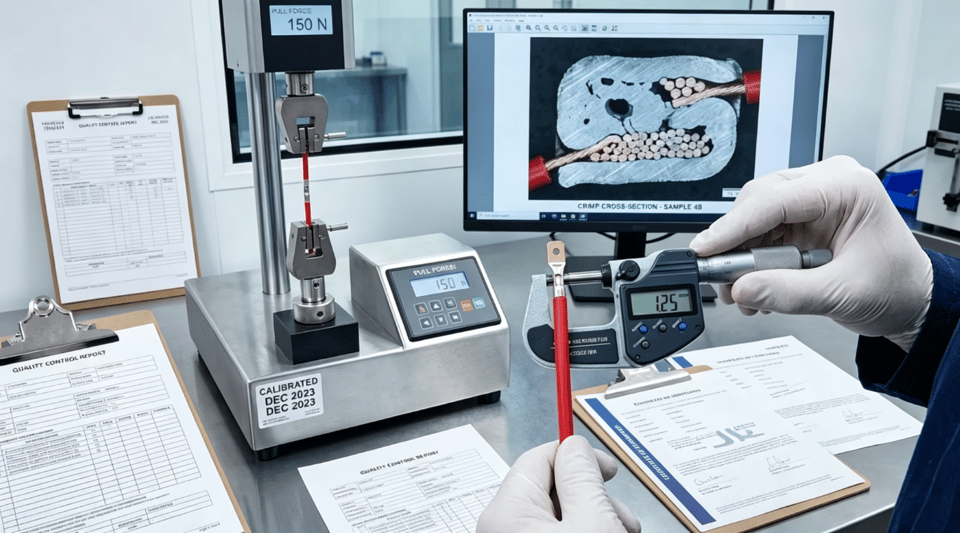
1. How Crimp Connections Work
A crimp connection is formed by mechanically compressing a metal terminal around a stripped wire conductor using a dedicated crimping tool. When executed correctly, the terminal and wire strands are cold-welded together, creating a solid mechanical bond and a stable electrical interface.
Crimping is widely used across industries such as automotive manufacturing, industrial automation, renewable energy systems, and heavy machinery. Its popularity is largely driven by its repeatability and suitability for large-scale production environments.
2. How Solder Connections Work
Soldering involves melting and cooling an alloy composed of lead, tin, brass, or silver into solder cups to bond a wire conductor to a contact. This method is typically recommended for general-duty and industrial applications that require reliable signal and power connections. Unlike crimp terminations that require specialized tools, nearly any size wire and solder contact can be terminated with a basic soldering kit.
3. Advantages of Crimp Connections
A properly executed crimp forms a gas-tight connection, preventing oxygen and moisture from reaching the conductor. This significantly reduces the risk of corrosion, oxidation, and increased contact resistance over time.
Crimped terminals offer superior resistance to vibration, shock, and mechanical stress. This makes them especially suitable for dynamic environments such as vehicles, industrial equipment, and power distribution systems.
Crimping is also more consistent than soldering, which can vary according to the method used or the skill level of the technician.
4. Limitations of Solder Connections
Solder joints are inherently rigid. Under vibration or repeated mechanical stress, soldered connections are more prone to cracking or failure compared to crimped joints.
Soldering is labor-intensive and time-consuming, which limits its efficiency in high-volume manufacturing. Quality is also operator-dependent and can vary according to method or technician skill.
Specifying crimp-then-solder because 'both is better' guarantees failure. Soldering a crimp anneals the cold-worked copper, reducing tensile strength by 60% while guaranteeing stress concentration.
5. Industry Standards Favor Crimping
Crimping delivers superior reliability over soldering in high-vibration, thermal cycling, and harsh-environment applications. Industry standards including SAE/USCAR-21, IEC 60352-2, and IPC/WHMA-A-620 mandate crimped connections for automotive and aerospace applications where a 15-year service life under extreme conditions is non-negotiable.
6. When Soldering Is Still Preferred
Soldering remains valuable in electronics and specialized applications where precision is paramount. Soldered joints provide low contact resistance, which is beneficial for signal transmission in sensitive electronic circuits. Soldering allows for fine, detailed work, making it suitable for densely packed electronic components and intricate wiring layouts.
7. Comparison Summary
Parameter | Cold Crimp Terminal | Solder Terminal |
Connection Method | Mechanical compression (cold weld) | Thermal fusion with alloy (Sn/Pb/Ag) |
Vibration Resistance | Excellent — flexible at stress point | Poor — rigid, prone to cracking |
Moisture / Corrosion | Gas-tight seal — highly resistant | Open joint — susceptible to oxidation |
Production Speed | Fast — automation compatible | Slow — labor-intensive |
Quality Consistency | High — tool-controlled | Variable — operator-dependent |
Best Application | Automotive, aerospace, industrial, EV | PCB, electronics, low-volume, precision signal |